
AI can now match, and sometimes even outdo us at creative outputs; in one study, readers preferred AI “Shakespeare” to the real thing. But creativity isn’t only a product, it’s a process. From the Jungian perspective, it is a necessary part of the individuation process through which we become more fully ourselves. AI can support that process or enable us to circumvent it the responsibility of how we use it is ours.
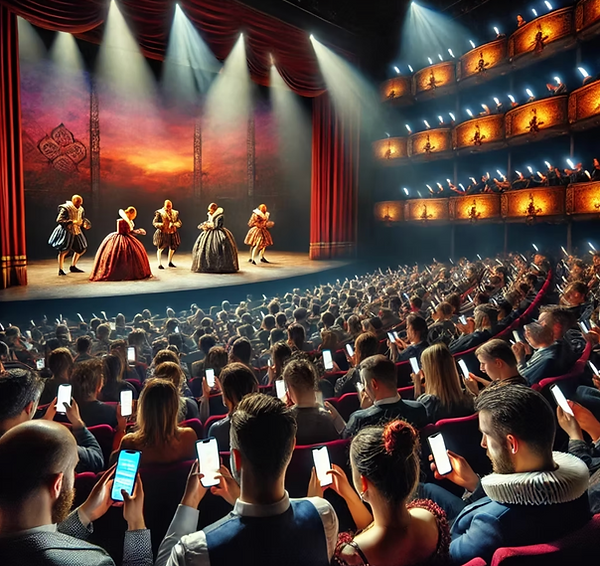
Creative types never used to worry about machine automation – at least not when it came to their jobs. After all, automation was limited to repetitive and mechanical work, right? Machines weren’t going to be replacing writers, poets, and painters anytime soon — or were they? Research out this very week revealed that poetry written by AI in the style of Shakespeare was indistinguishable, to non-expert readers, from that written by the Bard himself — enough to have creatives shivering down to their alliterative arses. To add insult to injury, the readers in the study preferred the poetry written by a robot, stating that it was more accessible and relatable than the actual Shakespeare.
It’s funny, isn’t it, that AI innovations should continue to surprise us at such quickening intervals. The whole point of AI is to simulate human processing so well that it can do things previously only we could — and voilà, suddenly here we are. After all, what’s more human than the creative act? But wait — can we really say that the art AI is generating is truly creative? If so, if not, what does that mean for us mere humans, for whom creativity may be more important than we realise (and that’s true for creatives and non-creatives alike)?
AI has demonstrated remarkable capabilities in generating art, music, literature, and even complex problem-solving. Tools like DALL·E, MidJourney, and DeepArt can create stunning visual art from simple text prompts, while AI-driven platforms can compose music and write poetry. These advances raise intriguing questions about the nature of creativity itself, and what role AI may have in augmenting or inhibiting human potential.
“Human agency in the creative process is never going away.”
These words by Anne Ploine, one of the authors of the AI and the Arts report from the Oxford Internet Institute, may be reassuring, but there’s evidence all over the place suggesting otherwise – at least when it comes to producing creative “outputs” like classic (sounding) sonnets. We’ll get into the difference between creative output and creative process below, but mark my words, AI is already starting to do a lot of stuff we thought only humans could do — and this is consequential not just for what ends up in our libraries and galleries, but for human psychological development itself.
Creativity Isn’t Just About Pretty Outputs — It’s About Self-Realisation and Social Transformation

From a Jungian perspective, creativity is not merely a snazzy skill some of us might have: it’s a crucial component of the human psyche that gives human life meaning. When we put our minds to a creative task, we access our deeper motivations alongside constellations of thought, memory, experience, and emotion that reside within the unconscious. Pursuing creative acts keeps the channels open between our conscious and unconscious minds, and helps us grow more deeply into the unique individuals that we are — and this contributes to the progression of society as well.
Beyond just ourselves, creativity serves as a direct (though more often frustratingly indirect) path to the collective unconscious, a place where we may encounter symbols and archetypes that resonate with universal human experience – across ages and cultures. With AI’s capacity to process vast amounts of data and generate novel outputs all by itself, what role might it have in the human creative journey?
Jungian Theory and the Individuation Process
For Jung, the personal development journey toward self-realisation is referred to as individuation. The main task is to grow the Self through the integration of the variety of elements that lie hidden in the unconscious. In this model the ego, or the “I”, is just one small part of the Self: a part of conscious life and personal identity that sits within a much wider matrix of phenomena (memories, complexes, instincts, drives, motivations, patterns of behaviour, and so on) encompassed by the Self.
Jung suggests that we can transcend the limits of our ego (including old narratives about who we are) and our complexes (patterned ways of being based on past experience) to become a freer, more liberated, and more authentic version of ourselves. Creativity plays a crucial role in individuation because it enables us to seek within ourselves new ways to express unconscious material — to free it from the unconscious and make it available for more conscious integration into the Self.
Whether AI will be a facilitator or inhibitor of individuation is something we will soon find out – I expect, like most things, it will be both, depending on how we engage with it. On the positive side, AI has the capacity to draw on massive archives of information about our collective past, across generations and cultures, that may generate images, stories, and music that tap into the archetypal collective. AI can help individuals without a particularly honed skill in the creative arts to explore and understand their inner worlds — for example, by illustrating or making a video of a dream.
On the negative side, AI may offer us a way to opt out of the hard graft of creativity too easily. As I’ve written elsewhere, we need a certain degree of hard graft and challenge to learn and grow. If we choose the lazy option (as we humans so often do) we may be crippling our own potential by choosing ease and stagnation over challenge and personal growth. I know it’s a cliché, but often there really is no gain without pain.
Furthermore, while AI can help us break out of our perpetually biased minds and open us up to ideas we previously wouldn’t have considered, it also risks reducing the variety of ideas we encounter as a whole. After all, AI only looks back; it can make some pretty surprising integrations and juxtapositions, but innovation and true novelty come from looking forward, not from being stuck on the past.
Two Kinds of Creativity: Compensation and Individuation
For Jung, creative works like fiction can serve a compensatory or an individuative function.
Compensatory creativity works by bringing to light aspects of the psyche that may be neglected or repressed — trying to balance out the psyche by integrating opposites. Think of a very calm and peaceful person having violent dreams. There’s also a less helpful version (which may look more familiar to many of us): the passive consumption of material that tends to remove us from life rather than taking us further into it. We may compensate for feeling unhappy or unfulfilled by turning ourselves into zombies in front of Netflix for hours; we may watch romance films to compensate for feeling lonely, or violent films instead of feeling angry. This kind of compensation isn’t terrible in itself, but it’s best not to make a habit of it.
Individuative creativity is a more conscious approach, in which one makes space for exploring and integrating unconscious material. This can be done through the process of amplification, whereby one amplifies a dream or creative narrative (or even a feeling, projection, or thought) to see where it leads. Creativity with an individuating purpose is used as a way to explore the self — to paint or write yourself into a fantasy while not knowing where it’s taking you.
AI-generated fiction and art can fulfil both functions, both for good and for ill (psychologically, anyway). By creating content that reflects diverse perspectives and experiences, it may help individuals see beyond their conscious biases and assumptions, leading to a deeper understanding of oneself and others, and fostering empathy and personal growth.
“AI models can extrapolate in unexpected ways,
draw attention to an entirely unrecognised factor in a certain style of painting
[but] they aren’t going to create new artistic movements on their own.” — Anne Ploine
At the same time, AI can throw up standard, cliché patterns that fail to move us — in fact doubling down on old dynamics, which would in effect shrink rather than expand the realms of the Self, sucking the wind out of the individuation process. This works in the creation of art as much as the consumption of it. One of the reasons the participants in the study mentioned at the top of this post preferred the AI creations is that they felt they were more digestible.
But is digestibility what we’re really looking for? Isn’t there satisfaction to be gained in the effort it takes to understand a difficult sonnet? The difficulty is part of the point. It may be hard to get your head around James Joyce — but is settling for an AI-produced, more consumable narrative really the key to personal growth? Granted, it may not be James Joyce either, but you get the point.
Ethical and Psychological Implications: More of What We Want and Less of What We Need
There’s no going back. When given a measure of creativity called the Alternative Uses Task (AUT), ChatGPT-3 performed on a par with other humans; ChatGPT-4 now ranks among the top percentile according to human judges. Considering that the AI we’re using right now is, in fact, the worst AI we’ll ever encounter between now and the future, the next iteration is sure to beat us all. So while AI may replace a lot of our artistic outputs, it won’t replace our requirement to engage in creative processes in order to individuate. So it is we ourselves who will have to take responsibility for that.
The intersection of AI, creativity, and individuation offers a rich field for further exploration in depth psychology. As we keep integrating AI into our creative lives, the task is to stay awake to the ethical, psychological, and social implications — and to protect the effortful, sometimes uncomfortable creative work through which we actually become ourselves.
This essay is part of The Digitally Mediated Self hub/ For the related argument about AI, therapy, and emotional life, see the Mental Health in the Age of AI hub.
FAQ
Can AI be truly creative?
AI can produce impressive outputs — sometimes ones people prefer to human work. But creativity is also a process, not just a result. AI performs creativity; it doesn’t undergo the inner, unconscious work that makes a creative act meaningful for the person doing it. The output can be real; the developmental experience is what’s missing.
What is individuation?
Individuation is Jung’s term for the lifelong process of becoming more fully oneself — growing the Self by integrating material that lies hidden in the unconscious, rather than staying confined to the narrow “I” of the ego. Creativity is one of its main vehicles.
What’s the difference between compensatory and individuative creativity?

Compensatory creativity balances or distracts the psyche — a calm person’s violent dreams, or bingeing Netflix to manage an unwanted feeling. Individuative creativity is a more conscious effort to explore and integrate unconscious material in order to grow. AI can serve either, but it makes the compensatory, frictionless option far easier to reach for.
Will AI replace artists?
It may replace a great many creative outputs. What it can’t replace is our need to engage in creative processes nor appreciate others' work in order to individuate. The work of becoming ourselves can’t be outsourced — so the responsibility to keep creating stays with us.
What does “tech gives us what we want at the expense of what we need” mean?
Technology is brilliant at lowering the bar to ease, so we tend to choose the easy option even when the harder one would serve us better. With creativity, handing the hard graft to AI can quietly cost us the growth that the effort itself would have produced.
Further Reading
AI and the Arts: How Machine Learning is Changing Artistic Work — Oxford Internet Institute
The Future of Employment: How Susceptible Are Jobs to Computerisation? — Carl Benedikt Frey and Michael A. Osborne
The Creativity Code: How AI is Learning to Write, Paint and Think — Marcus du Sautoy
Artificial Intelligence: A Guide for Thinking Humans — Melanie Mitchell
Stay up to date with my Substack Newsletter.